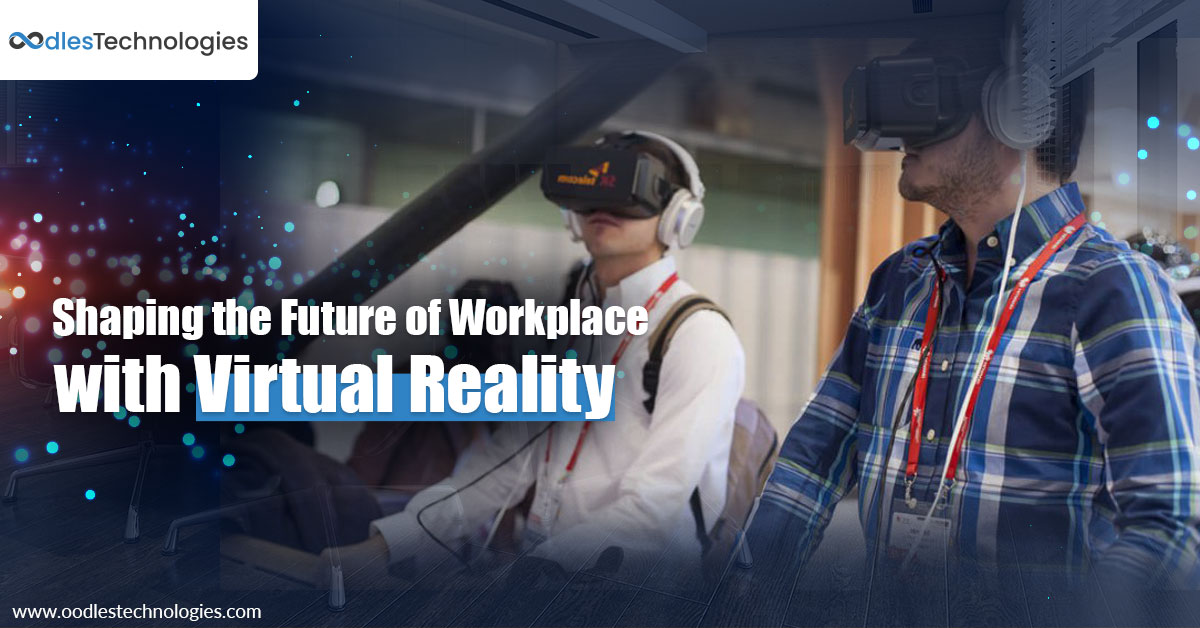
Shaping the Future of Workplace with Virtual Reality

Originally the use of Virtual Reality Technology was associated with gaming. After realizing its potential in the entertainment sector various industries are now using it to drive sales revenue and improve workplace conditions. In this article, we will discuss how virtual reality can shape the future of the workplace.  

VR App Development Company

The trend of Virtual reality got popular with game-obsessed teenagers wearing goggles, fascinated by floating through space directly from their home. After Virtual Reality’s success in the entertainment sector, this technology is now implemented at various organizations to accelerate processes.  We as an AR VR app developers receive requests for designing Virtual Reality app that facilitates in the progress of an organization.

The  Futuresource Consulting reports confirm that the VR market volume is expected to reach 98.4 million sales by 2023. 

Facebook acquired Oculus VR in 2014 and since then it is a prominent player in the space. It was anticipated that the company may spend more than $5 billion annually on VR in the coming years.   

Various virtual reality applications have the potential to shape the future of various industries including journalism, healthcare, and manufacturing. 

Employee Training with Virtual Reality: Leading organizations like Walmart partnered with Virtual Reality creator Strivr, to train employees for its Black Friday sale. Using the immersive technologies employees are trained for an event they are not used to. Virtual headsets like Oculus are used to create a virtual environment for the employees to enable them to deal with life-like situations. 

Oculus VirtualSpeech enables employees to enhance their public speaking skills within a stipulated environment. The employees can upload their presentation slides that include a virtual room to identify the areas of distractions. The technology provides real-time feedback to the employees to enable them to improve their skills. Medical practitioners use VR technology to enhance their skills in a risk-free but life-like environment. The Children’s Hospital of Los Angeles (CHLA) used Oculus devices to train its staff to deal with the patients of high-risk pediatric trauma.

Healthcare

Current applications of Virtual Reality in healthcare include pain management and physical therapy.  The technology has the potential to mitigate pain. A VR app named “Cool” was used to examine the effects of VR on patients suffering from chronic pain.  DeepStream VR developed the Cool app in 2014 examined that VR reduced 60 percent pain of the patients while 30 percent of patients were diagnosed with a disease.   

Behavioral Medicine Institute Clinical Pain Psychologist, Dr. Ted Jones, believes that virtual reality can turn to be the best alternative to opioids in pain treatment. 

In an article published in Clinical Pain Advisors, Jones said that “We could be on the verge of a new era of pain treatment in which medications are rarely used, and VR is a primary treatment modality.”

Oculus headsets are also used by doctors for patients dealing with trauma. Traumatized patients are given headsets to focus on the objects that bothering them. 

Manufacturing

Manufacturing industries have started using Virtual Reality to accelerate the process of product designing. PricewaterhouseCoopers (PwC) conducted a survey in 2015 and found that 72.5 percent of U.S manufacturers use virtual reality and  Augmented reality in U.S manufacturing industries. 

AR VR App Development Company

PwC explains how Virtual Reality is used by Manufacturers: Immersive technology is used by companies for remote maintenance. A field technician relays a live image of a product that requires fixing. The remote colleague provides instructions, data or images that enable the field technician to repair it easily. Field technicians use Smart Glasses to ensure all parts are assembled in the right sequence.

VR App Development Company

Collaborative Human Immersive Laboratory (CHIL) product designers use virtual reality to collaborate on building virtual prototypes. Virtual reality has played a significant role at Lockheed. It enables technicians to practice assembling and installation of components. Lockheed explains that Virtual reality enables product engineers and technicians to test, validate, and understand products early in program development, especially when the risk, cost, and time associated with making modifications are comparatively low.”

Journalism

Virtual Reality facilitates a new method for storytelling. It is significant that technology is poised to play a great role in the field of journalism. Immersive content can enable journalists to tell stories. The Associated Press conducted a research in 2017 and determined that 3D content production will be a part of the newsrooms across the globe. Also that the 3D content will also change the way journalists tell stories and people consume news.  According to the New York Timepiece 2017 research, “Life on Mars,” various 360-degree videos were used to enable the readers to understand Mars-like conditions. During this study, the NASA research team lived on an isolated volcano Mauna Loa volcano in Hawaii. 

Guardian also published a number of content pieces in its virtual reality app. The app enables readers to readily access virtual reality journalistic content.

Are you planning to use Virtual Reality technology to accelerate your business training or processes? We are a well established AR VR app development company that enables businesses to unleash the potential of the technology and use it to accelerate their processes. 
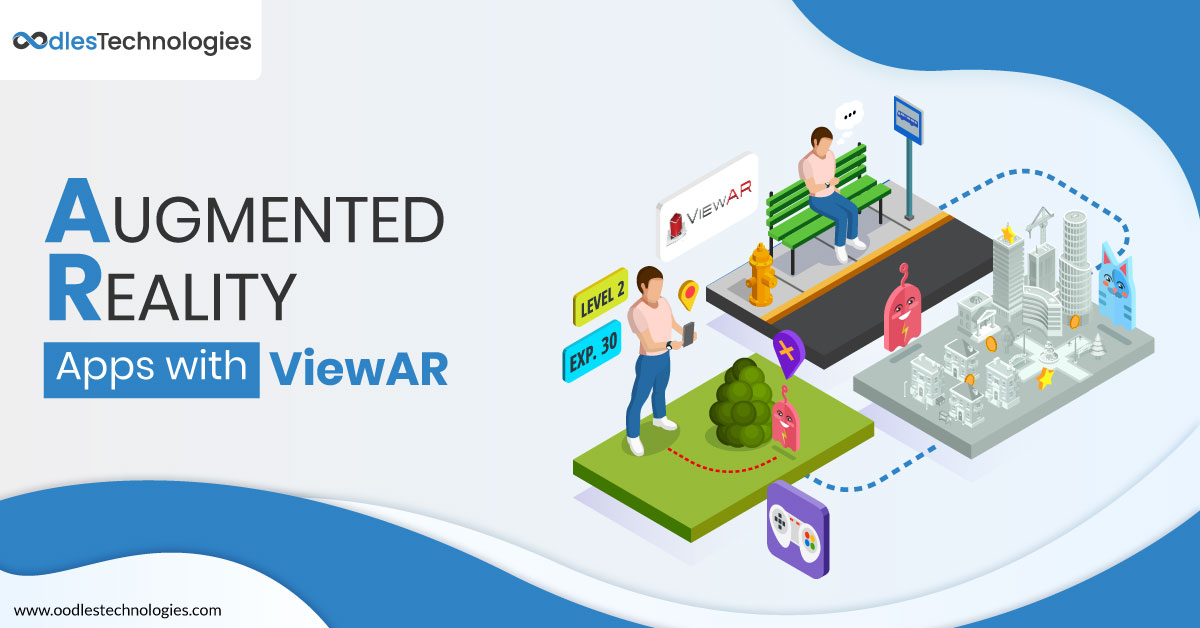
Building Augmented Reality Apps with ViewAR

The rising popularity of AR apps is vindication that tech-savvy consumers have an inclination for immersive experiences. Businesses looking to monetize this trend can take advantage of AR development toolkits to accelerate time to market for AR apps. Let’s explore ViewAR, a leading toolkit that is popular among AR app developers. 

The ViewAR SDK is replete with interactive modules that developers can choose from. It supports all tracking systems including ARKit, ARCore, Wikitude, etc. ViewAR is powered with Vuforia Engine that is effective for creating interactive apps. It enables users to move around virtual objects and view them on the right scale. The easy to use app builder can even customize business apps with a user-friendly configurator view. Developers can change the background color, buttons, and texts effortlessly using ViewAR’s intuitive development interface.  

ViewAR Success Story 

ViewAR provides consumer businesses several business opportunities with deeper audience engagement. The very famous BeoHome Design app was created with a ViewAR builder. The app successfully delivered a compelling experience to millions of customers that made it won the “Best App” category at Augmented World Expo 2016.  

ViewAR Use Cases 

Wolken Werk– Wolven Werk is an Augmented reality apartment building app developed using ViewAR. The app is for architects and engineers to create complex 3D/2D models and Build Information Modelling (BIM) to construct new apartments. With this app, architects can give their clients an exact idea about how a project or construction site will look after completion. 

Royal Botania – Belgian outdoor luxury furniture retailer Royal Botania uses a ViewAR app to sell its merchandise. They have featured 40+ products customized in 30+ material finishes in their app. Shoppers can virtually try Royal Botania’s products in their homes to select the most appealing options. ViewAR’s ARKit tracking system enables shoppers to mark terrace corners. In addition, they can add doors, building walls, and windows within the app to generate a 3D model of the desired space. 

Markilux– Markilux has a great name in offering affordable awning covers for patios and conservatory to protect solar panels, terrace furniture from rains and sunlight. Markilux used ViewAR to create a feature-rich 3D AR app. The app’s AR-mode provides marker-less experience with precise measurements so shoppers can enjoy their awning buying experience. 

Implenia Raunheim: Implenia Raunheim is an AR app built using ViewAR. The app was designed for employees to make the orientation easier. The app is imported with a BIM model to showcase room information and furniture layout in a newly constructed office. The app enables users to access 3D model enriched rooms, find the shortest way to coffee machines even before they enter the building. 

We build AR apps using Amazon Sumerian toolkit and Facebook Spark AR Studio too 

Some areas where AR apps can be built with ViewAR 

Education: AR creates an immersive environment for students to make learning easier. It replaces the traditional way of learning to enhance the skills of the students. It can be used to inculcate special skills in them to enhance their overall personality. 

Retail: AR plays a significant role in today’s physical retail environment. Harley Davidson is branding its products through the AR app to enable users to use showroom products. Shoppers can view an in-store motorcycle, customize its colors and features using the app. 

Design and Modelling: AR  is frequently used by architects, engineers, and design professionals to create – Build Information Modelling (BIM). It enables designers to visualize the final products before its ready. It can be used to show clients in advance how a particular construction site will look after completion.

Medical Training: AR technology creates an immersive environment for medical students. It plays a critical role in virtually training employees to perform an MRI or a complex surgery. Medical personnel can use AR to learn new operation techniques without risking a life. For example, simulation can be created to train surgeons on using a new variety of surgical instruments.  

AR VR app development companies are using ViewAR as an app development tool for creating interactive AR apps for its customers. The platform is increasingly used for creating industrial apps, real estate apps and more. The app builder creates apps for improving brand engagement, increasing business sales and profit. 


Are you planning to upgrade your business apps with AR, VR and MR technologies? Talk to our software developers today. We are an Augmented Reality app development company that builds robust and feature-rich applications for enterprises across the globe. We enable businesses from retail, real estate, and healthcare to incorporate AR, VR and MR technologies to provide immersive experiences. For more details contact our experts today 


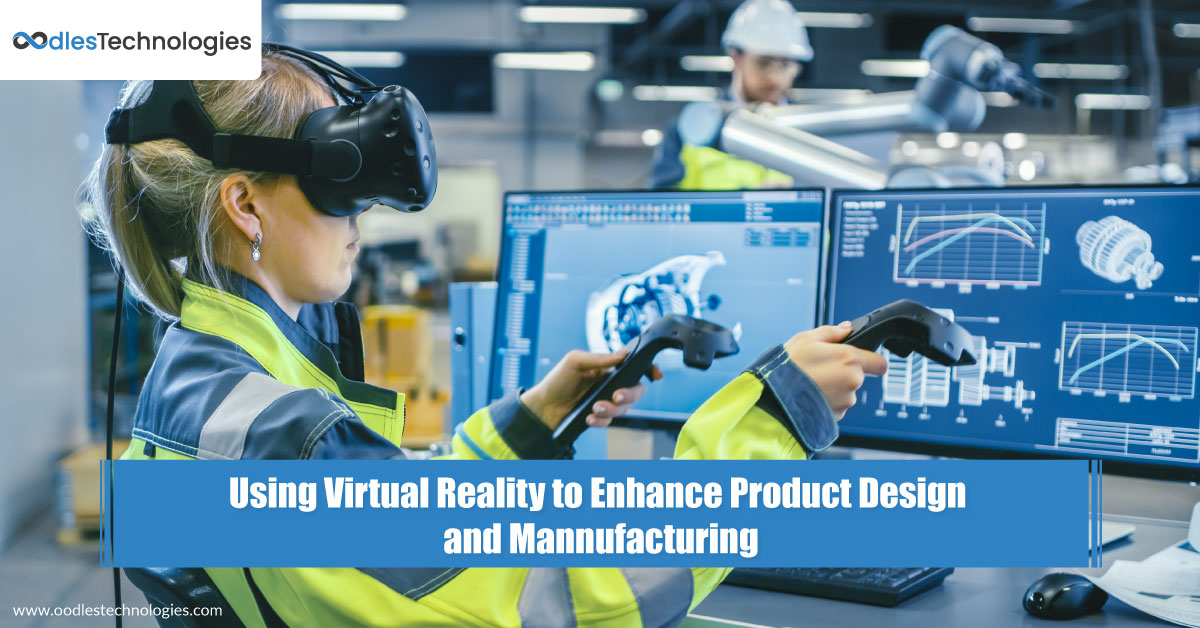
Using Virtual Reality to Enhance Product Design and Manufacturing

According to Fortune research, Virtual Reality is all set to generate a revenue of $150 billion by 2020. 

According to Piper Jaffrey, around 500 million headsets will be sold by 2025

According to Neilson’s research, the awareness for virtual reality devices increased from 28% in 2016 to 51% in 2017. 

The rising demand for VR headsets is an indication that companies are using Virtual Reality (VR) technology to accelerate business growth. The use of Virtual Reality technology is also visible in product design and manufacturing. Traditionally businesses followed iterative product analysis that leads to a delay in product development. Businesses can use VR to create a computer-generated environment for simulating manufacturing processes or product designing and accelerate product development cycles. Oodles Technologies AR VR apps developers receive requests for VR apps that enhance product design and manufacturing processes. We provide AR VR app development services using technologies like SparkAR and ViewVR.
 

Let’s find out what benefits Virtual Reality can offer in product design and manufacturing. 

Enhances Design: Virtual Reality uses a computer and other visual technologies to provide a virtual environment for product development. The technology reduces the time spent on iterations in product designing. VR provides intuitive ways to accelerate product designing in industries. Using Virtual Reality technology manufacturers and clients can thoroughly study the design and evaluate it from a holistic point of view. The technology is highly beneficial in the designing of products in industries where there is no scope for errors. The technology enables manufacturers to more accurately depict and create immersive 3D models. Designing engineers with the help of immersive technologies can view their models from different angles to get a better understanding of it. 


NASA to design the space shuttle created a life-sized model of the ship with wood and plastic. Creating a virtual model enables the research team to accelerate their project and its completion. 

Facilitates Collaboration Of Designers: Virtual Reality facilitates collaboration between the designers. It uses the floor and wall projections to enable designers to collaborate within the unique space. The technology enables product engineers from across the globe to work in collaboration with engineers at different locations. The innovate collaboration of teams not only saves time but money as well. Virtual Reality Application development can enable product engineers to collaborate with outer engineers from across the globe. 


VR Product Modeling: VR accelerates product designing by providing product models to the engineers that are close to reality. Product engineers can save themselves from critical thinking of designing a product. Also, with the current 3D and 4D model visuals, designers can evaluate any drawbacks before a product is made. In case of discrepancies changes in the design can be made before the completion of the product design.  

Product designing is difficult and requires critical understanding. Product engineers look after various designing aspects to present designs that accomplish every demand of the consumers. VR can play an essential role in the design of products. It is used by architects or real estate businesses to present a virtual model in front of their clients.  

Would you like to enhance or accelerate the designing of products at your organization? Contact our VR App developers to know how they can help you with the product designing. 

Using Virtual Reality to Enhance Product Design and Manufacturing

According to Fortune research, Virtual Reality is all set to generate a revenue of $150 billion by 2020. 

According to Piper Jaffrey, around 500 million headsets will be sold by 2025

According to Neilson’s research, the awareness for virtual reality devices increased from 28% in 2016 to 51% in 2017. 

The rising demand for VR headsets is an indication that companies are using Virtual Reality (VR) technology to accelerate business growth. The use of Virtual Reality technology is also visible in product design and manufacturing. Traditionally businesses followed iterative product analysis that leads to a delay in product development. Businesses can use VR to create a computer-generated environment for simulating manufacturing processes or product designing and accelerate product development cycles. Oodles Technologies AR VR apps developers receive requests for VR apps that enhance product design and manufacturing processes. We provide AR VR app development services using technologies like SparkAR and ViewVR.
 

Let’s find out what benefits Virtual Reality can offer in product design and manufacturing. 

Enhances Design: Virtual Reality uses a computer and other visual technologies to provide a virtual environment for product development. The technology reduces the time spent on iterations in product designing. VR provides intuitive ways to accelerate product designing in industries. Using Virtual Reality technology manufacturers and clients can thoroughly study the design and evaluate it from a holistic point of view. The technology is highly beneficial in the designing of products in industries where there is no scope for errors. The technology enables manufacturers to more accurately depict and create immersive 3D models. Designing engineers with the help of immersive technologies can view their models from different angles to get a better understanding of it. 


NASA to design the space shuttle created a life-sized model of the ship with wood and plastic. Creating a virtual model enables the research team to accelerate their project and its completion. 

Facilitates Collaboration Of Designers: Virtual Reality facilitates collaboration between the designers. It uses the floor and wall projections to enable designers to collaborate within the unique space. The technology enables product engineers from across the globe to work in collaboration with engineers at different locations. The innovate collaboration of teams not only saves time but money as well. Virtual Reality Application development can enable product engineers to collaborate with outer engineers from across the globe. 


VR Product Modeling: VR accelerates product designing by providing product models to the engineers that are close to reality. Product engineers can save themselves from critical thinking of designing a product. Also, with the current 3D and 4D model visuals, designers can evaluate any drawbacks before a product is made. In case of discrepancies changes in the design can be made before the completion of the product design.  

Product designing is difficult and requires critical understanding. Product engineers look after various designing aspects to present designs that accomplish every demand of the consumers. VR can play an essential role in the design of products. It is used by architects or real estate businesses to present a virtual model in front of their clients.  

Would you like to enhance or accelerate the designing of products at your organization? Contact our VR App developers to know how they can help you with the product designing

Accelerating Web Development Using Azure App Services

This blog post highlights the key benefits of using Azure managed services to accelerate cross-platform app development processes.

Platform as a Service (PaaS) has become an increasingly popular medium for web development with significant advancements over recent years. The benefit of using these platforms is that you get access to integrated cloud services to organize and safeguard enterprise data. In addition, most PaaS platforms support high-level languages like Java, Python, PHP, Ruby, and .NET. Since most developers are well-versed with these languages, they can easily learn PaaS techniques to accelerate their development efforts.   

Azure App Service is a PaaS platform introduced by Microsoft to strengthen its cloud-based web services architecture. It provides a fully managed platform to developers for building, deploying, and scaling cross-platform web and mobile applications. Azure PaaS provides requisite tools and integrated cloud services to build robust and scalable web/mobile applications, APIs, and Logic apps. 

Azure Service Fabric
Azure service fabric is a distributed application platform that enables developers to build and deploy microservices-based enterprise applications. It simplifies the deployment of packages and containers to build and manage enterprise-grade and cloud-based applications running in containers. The service fabric enables organizations to overcome complex enterprise challenges that generally arise while developing and managing cloud-based native and hybrid applications. Below is a simple representation of Azure Service Fabric.

The above architecture diagram represents the capabilities of Azure App Service in conjunction with a series of virtual machines. While the legacy systems require connecting to a web server, the Azure Service Fabric employs virtual machines to provide web server functionality. It eliminates the requirement for acquiring and managing a web server.    

Also read Benefits of Implementing Cloud Based DevOps in Healthcare

Building Web Apps and APIs
Azure enables developers to code in supported languages like Java, Python, PHP, Ruby, and .NET and deploy these codes in containers. The fully managed Azure platform provides intuitive tools and integrated services for web app development, management, and monitoring. Developers can avail prebuilt apps from the Azure marketplace and customize them as per their project requirements. They also gain access to advanced tools such as Microsoft Visual Studio and Visual Studio Code IDEs for seamless integration and live-site debugging.     

IT Infrastructure Management
Azure provides organizations complete control over their IT infrastructure as they can easily run and scale web applications on Windows or Linux-based interfaces. In addition, they get reliable tools for infrastructure maintenance and load balancing with zero downtime and minimal disruptions.  

Azure makes it easy to meet the compliance requirements by enabling developers to add custom domains, SSL certificates, and single sign-on (SSO) features to web applications. Developers can timely detect bugs and software issues by routinely monitoring application health insights for better performance optimization and troubleshooting. 

Seamless App Hosting Services
Microsoft Azure provides an enterprise-grade platform to build and host web applications in your preferred programming language without any infrastructure complexities. With Azure, you don’t need to run and manage a web server which significantly reduces costs and accelerates the deployment cycle. Besides, developers use Azure Active Directory to add and manage 1000+ apps.

Azure hosting services enable developers to connect a web or mobile application to an enterprise system and deploy it in a public/private cloud, virtual network or on-premise system.  

You may also like Benefits of Using Python for Web App Development

Accelerated App Development
Azure app platform accelerates web development by providing automated provisioning and deployment services. Web applications developed using Azure App Service are easy to manage, scale, and deploy. In addition, Azure provides auto-scaling and traffic management capabilities for effective performance optimization without any data loss or downtime.

Avail Our Azure DevOps Services For Faster Development 
We, at Oodles, provide end-to-end Azure managed services and DevOps solutions for cross-platform web application development. Our Azure DevOps services render agile and streamlined IT operations with automated workflows to accelerate customer delivery services. In addition, we provide 360-degree DevOps consulting services to intelligently drive business enterprises toward their future goals with strategic planning. 

Benefits of Implementing Cloud Based DevOps in Healthcare

The healthcare industry generates large amounts of data every year. While processing the data healthcare companies have to follow multiple regulations to ensure strict security.  Implementing DevOps approach to infrastructure management ensures a high level of security in data management. 

Traditionally whatever data was generated by the healthcare industries was stored in the files that remained on the shelves for years. Lack of a stringent security system enabled internal staff members to misuse the data. Over the decades’ the healthcare industry matured and started utilizing IT technology. The data was saved on the private cloud infrastructure to prevent its misuse. 

Oodles Technologies provides Cloud-based DevOps services to enable data security and efficient product delivery. 

DevOps approach in the enterprise healthcare industry can facilitate in the right distribution of data. 

As stated by Amazon Chief Technology Officer (CTO), Dr. Werner Vogels during his speech at AWS Summit London 2018, the Infrastructure-as-a-service component of AWS  is fine-tuned for security.  

The enterprise healthcare industry needs to adopt an efficient cloud infrastructure that ensures Big Data security and even distribution.   Currently, Amazon’s Infrastructure-as-a-service provides Machine Learning (ML) optimized Big Data solutions. 

Big Data analytics and DevOps benefits for Healthcare

Troves of data generated by the healthcare industry every year can be used for research work. Doctors can use the data to conduct their research on various diseases through data analysis. Research teams at various hospitals use conventional servers that are inefficient to deal with the 3 V’s of the Big Data. 

  • Variety of data types gathered
  • The Volume of data to process
  • The Velocity of the incoming data  

To manage the 3V’s of the Big Data, companies are required to develop and deploy Machine Learning (ML) models and process the data. Artificial Intelligence algorithms analyze data to discover hidden patterns and use them to generate actionable insights. For deploying the Big Data Visualization tools a flexible and resilient infrastructure is needed that enables the 4th V(value) of Big Data. 

Solution with DevOps

Implementing DevOps-as-a-Service (DAAS) enables auditing of IT infrastructure, assessing possible obstacles, and suggesting ways to dealing with them. The solutions often suggest moving the infrastructure to public clouds such as Azure, AWS, or GCP from legacy hardware. In parallel to moving the infrastructure from legacy to public cloud, continuous integration (CI) and delivery (CD) pipelines will support automated management and monitoring of data. Implementing DevOps approach provides various benefits: 

  • Reduced Operating Expenses: Prevents upfront investments including personnel training or server purchase. 
  • Easy scalability: Enables scaling up and down the resources on the bases of the data that is generated. 
  • Increased accessibility: Facilitates collaborating parties to easily access cloud resources
  • High availability:  Ensures the workload and  the apps are located in the availability zone closest to the customers
  • Fast deployment: DevOps tools minimize the time and effort needed to configure the servers according to the requirements of an organization. Cloud servers ensure 100% server security from hackers. Its secure structure mitigates several security threats. 
  • Better business agility: DevOps tools accelerate various processes in healthcare companies. It addresses various customer requests in a short time to deliver value to the customers. 

Some essential DevOps benefits specific to the healthcare industry include: 

Regulatory compliance and data security. General Data Protection Regulation (GDPR) in May 2018 became more stringent in monitoring and regulating the flow of an individual’s data. After this regulation was passed it became essential for healthcare institutes to limit access to patients’ data at their disposal. Implementing DevOps practices enabled healthcare institutes to secure their patient’s data on Cloud platforms. 

Cloud-based DevOps solution limited access to patient’s details and minimized the risk of backdoor access to the apps. DevOps-Infrastructure-As-a-service determines system functioning and removes multiple bottlenecks and potential security breaches. DevOps solutions automatically apply regulatory requirements and easily codifies to reduce operational overhead costs and simplify compliance checks from the authorities.

DevOps facilitates automation of daily routine tasks that motivates IT departments to concentrate on improving the infrastructure in use. It automates configuration checks, software updates, and database backups. DevOps approach enables the CI/CD pipelines to deliver results faster. 

Shorter time to market for your products. DevOps facilitates the automation of cloud infrastructure management so that the software delivery lifecycle becomes predictable for a software development company. It significantly reduces the time to market product updates. 

Better collaboration across the company. Implementing DevOps approach facilities easier collaboration between various departments. It speeds up various tasks of other teams and brings more efficiency and cooperation with big data teams. 

Implementing the DevOps approach in the healthcare industry provides effective use of Big data. It prevents the misuse of data and reduces the development cycle of apps. It also improves collaboration between the employees to facilitate better functioning.

Are you planning to implement DevOps solution to your healthcare institute? We offer DevOps consulting services to improve management processes, decrease cost, and deliver end-to-end agility.

Exploring Hybrid Cloud Solutions To Strengthen DevOps

Cloud computing has enabled several cross-industry businesses to drive digital transformation through effective data handling. An increasing number of companies are moving their business data to the cloud platform to reduce their capital expenditure and operational costs. Nevertheless, migrating business data to the cloud is only the first step towards digital transformation as there are numerous possibilities to drive digital growth. 

Development and operations in the IT sector, popularly known as ‘DevOps’ play a critical role in the digital transformation journey of an organization. DevOps strengthens the core development operations of an organization by bridging the gap between development and operations teams. Putting it this way, DevOps is an approach to formulate agile development methodologies with a focus on reducing the development lifecycle. In this blog post, we will explore ways to strengthen DevOps through hybrid cloud integration and cloud application development

The Importance of Having a DevOps Model

DevOps is gaining traction in software development because of its ability to deliver applications faster and maintain an efficient development workflow. 

Developers often face challenges like software performance issues, bugs, glitches, and system failure. Besides, they have to speed up their work cycle to meet users’ expectations. At the same time, operations teams are constantly under scrutiny as they are responsible for keeping systems up and running. 

DevOps combines the three phases of a software application lifecycle i.e development, testing, and production. It brings development and operations teams together to create a stable operating environment for faster code execution, reduced costs, and human errors. 

Also read Selecting Azure DevOps to Simplify Cloud Development.

Reasons For Implementing Hybrid Cloud

Hybrid cloud is a multi-faceted computing environment with a mix of private, public, and on-premises cloud services. Implementing hybrid cloud services in a business infrastructure can bring ample benefits such as increased scalability, flexibility, and cost savings. Hybrid cloud solutions introduce a number of hosting models to the IT infrastructure, thereby providing managers better control over business assets. 

Hybrid cloud solutions enable CIOs to move critical workloads between different hosting models to achieve business goals through effective resource handling. For example, an organization may store its sensitive business data on a private cloud while storing less critical data on a public cloud. 

Driving Digital Transformation Through Hybrid Cloud Solutions

A cloud platform, whether public or private, provides features like on-demand storage, networking, and other computing resources. Businesses and enterprises can use these features to effectively handle dynamic workloads like those from DevOps. 

Hybrid cloud infrastructure provides the right tools to developers for resource allocation and performance optimization. Besides, it enables dynamic resource provisioning, by rendering provisioned environments for on-premises or public cloud infrastructure. 

In addition, businesses can use several third-party tools to automate the provisioning and de-provisioning processes. The most popular provisioning tools are Ansible, Puppet, and Saltstack that are extensively used by companies to automate the creation of development environments. Using these tools enable businesses to create and implement development infrastructures dynamically, with minimal complexities. These tools also provide visibility into deployed development models through real-time reports.

You may also like Understanding the Amalgamation of AWS DevOps

Closing Thoughts

Implementing hybrid cloud solutions along with DevOps can accelerate the application development lifecycle and reduce business complexities. However, the process of hybrid cloud integration with DevOps comes with its own set of challenges. Using the right tools, at the right time is essential to reap the real benefits through both DevOps and hybrid cloud solutions. 

Besides, it is essential to have a clearly defined strategy to avoid business losses and ensure the smooth functioning of resources at reduced costs. Understandably, a large number of businesses refrain from changing their existing IT infrastructure due to all the risk factors involved. However, with the right strategy and the right team to implement a hybrid cloud in DevOps can do wonders for a business. It will not only strengthen their DevOps processes but also enables them to proactively achieve their future goals.

Why Choose Oodles For DevOps and Cloud Services?

We are a seasoned DevOps solutions company that provides end-to-end support for development, testing, planning, integration, and maintenance of software applications. Our DevOps consulting services intelligently drive cross-industry businesses with streamlined, agile, and automated IT operations. Avail our cloud consulting and application development services to automate your business processes and drive digital transformation through improved DevOps.

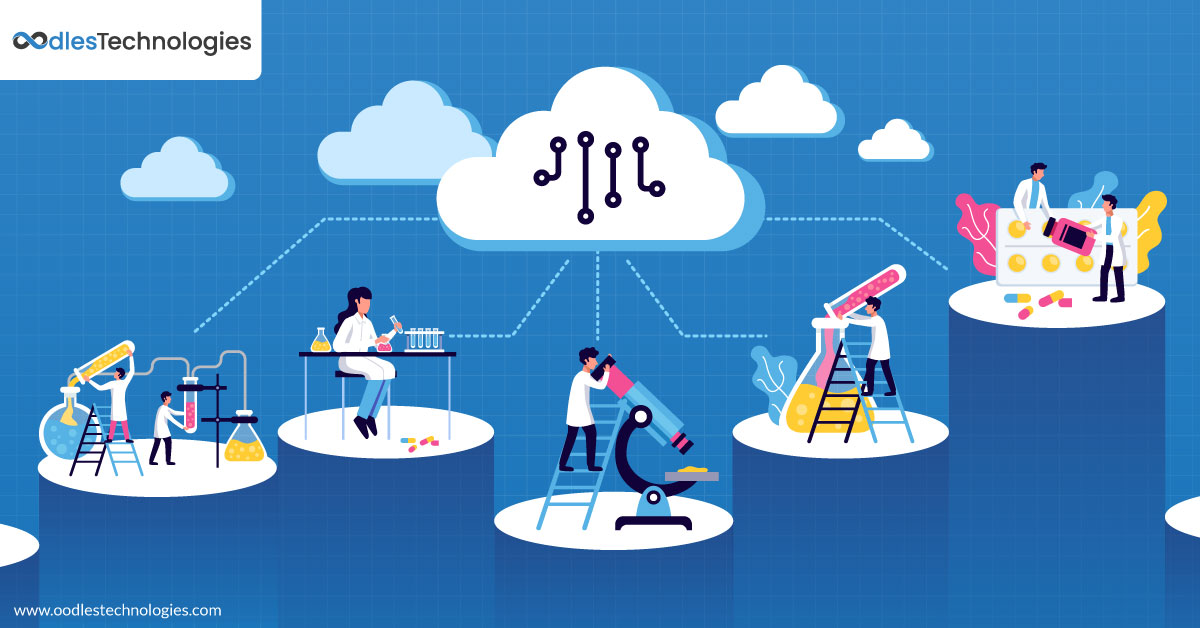
Exploring Cloud Computing Benefits for Pharmaceutical Companies

An increasing number of hospitals and medical institutes are relying on cloud computing for most of their data management processes. In fact, the whole healthcare industry is benefitting from cloud application development in one way or another. However, the adoption of cloud technology has been relatively slow in the pharmaceutical industry. A majority of pharma companies are using the cloud at the most fundamental levels while others are yet to adopt this technology. 

Nevertheless, when used in their core operations, cloud technology can radically transform the data handling capabilities of pharmaceutical companies. This blog post highlights the key benefits that pharma companies can achieve by implementing cloud technology in their core processes. 

Effective Data Management 

Pharmaceutical companies generate and process a huge amount of data on a daily basis. This data is normally generated through all sorts of clinical tests, product research, and market research. As a matter of fact, the clinical tests alone cost pharmaceutical companies a whopping sum of money every year. Cloud computing provides an opportunity to significantly reduce these costs and yield accurate results in almost half the time. Nevertheless, a majority of pharma companies are not fully utilizing their cloud resources for data management.  

Cloud computing provides pharmacists real-time access to trial data which is generated simultaneously as the clinical tests are performed. It enables them to timely detect underperforming sites and flag potential data quality issues. It also enables pharma companies to upgrade their Clinical Trial Management Systems (CTMS) for improved accuracy and faster data processing. 

In addition, a cloud-based CTMS system significantly reduces unnecessary expenses involved in conducting clinical trials. It eliminates the requirements for purchasing servers, installing applications, validating documents, and managing in-house data. In this way, it also enables pharma companies to meticulously complete clinical trials in weeks that would normally take months.

Easy Access To Information

Pharma companies, like all companies that rely on data and computation, require easy data retrieval and accessibility for seamless operations. However, for many of these companies, the data is not readily available across departments which causes uneven delays. In the absence of an effective data storage mechanism, the information is not readily available to employees across all departments. According to a survey conducted by Igloo, 43% of the respondents from SMEs claimed to have avoided sharing a document with a colleague because it was too hard to find. 

Pharma companies and hospital networks require instant access to information in compliance with the Drug Supply Chain Security Act (DSCSA). Moving to cloud-based solutions can enable these companies to streamline their data management processes and gain instant access to critical documents and research data. 

Multi-device Support

The pharma industry generates data in terabytes and petabytes every minute across multiple departments. The data contains invaluable information from R&D, clinical trials, and patients’ surveys. However, analyzing this data and extracting useful information is a challenging task for pharmaceutical companies.   

Cloud computing enables pharma managers to store large datasets on a global network that is accessible worldwide across multiple devices. Multi-device support provides an effective exchange medium for data from clinical research. This, in turn, enables pharma companies to function more efficiently with easy data accessibility. 

Time and Cost Savings

Implementing cloud technology in marketing and CRM operations of a pharmaceutical company can significantly reduce expenses as compared to traditional methods. Cloud eliminates the need for spending excessive amounts of money on software and hardware infrastructure. The data is readily available on the cloud in a secure storage facility. Besides, it mitigates uneven delays, saves time, and yields faster decision-making.   

Increased Security

For many years, security has been a major problem in cloud-based systems. It was one of the main reasons why most pharma companies refrained from adopting cloud technology. However, with recent technological advancements, cloud security has improved considerably. As of today, cloud is the most secure platform for data storage with multiple layers of security and encryption. Consequently, pharma companies can rest assured that their data is safe and is easily accessible across a wide range of devices.   

Use Oodles’ Expertise To Build Secure Cloud Applications

We, at Oodles, provide 360-degree cloud application development services for effective data management and processing. Our AWS cloud application development services ensure that your business achieves greater flexibility, agility, and efficiency at reduced costs.

Creating New Retail Experiences With Augmented and Virtual Reality

Augmented Reality (AR) and Virtual Reality (VR) are poised to strengthen the retail sector in the coming weeks or months. These are one of the most sought-after technologies that can benefit the retail industry through improved customer experiences. Several retail companies are already using AR VR app development services to enhance their marketing strategies and build customer relations. Besides, these technologies are set to revamp the shopping experiences of millions of customers worldwide. Goldman Sachs predicts that the global market for AR/VR in retail is expected to reach $1.6 billion by 2025. 

This blog post highlights the key elements of AR and VR that can benefit a large number of retailers, merchants, and online/offline shoppers. 

Increased Customer Engagement


The AR VR techniques are primarily being used to enhance customer engagement by delivering immersive user experiences. Augmented reality, when used in retail stores, can provide customers in-store navigation to easily find the products they are looking for. Additionally, customers can use AR-powered apps to locate a store that sells a particular commodity while roaming in their neighborhood. 

An increasing number of retail brands have launched AR apps to increase their customer engagement and build loyalty. These apps provide instant updates to customers about exclusive deals offered by a retail store in their locality. A large number of retail brands also use AR applications to run promotional campaigns and customer loyalty programs. 

Virtual reality takes customer experiences to a whole different level. The VR-powered virtual tours are gaining traction these days they provide immersive in-store experiences to customers even from a distant location. 

Personalized Shopping Experiences


A majority of retailers have experienced a significant increase in product sales after implementing AR VR techniques in their marketing strategies. A large number of e-commerce brands and retail companies use personalized marketing strategies to engage their target audience. They formulate their strategies in accordance with the increasing requirements of their customers for effective targeting. 

Augmented reality app development services can significantly improve their marketing efforts by delivering personalized customer experiences that maximize engagement and interactivity. With three-dimensional VR simulations, retailers can provide immersive in-store experiences to their customers from the comfort of their homes. VR marketing enables retail brands to promote their stores or a range of products and pull in more customers. 

Augmented reality has also become an effective marketing medium that provides customized shopping experiences. AR apps enable customers to easily locate a store, find products, and compare them on several quality parameters.   

Better Customer Satisfaction


Customer satisfaction is the ultimate key to build healthy customer relations. A large number of online/offline businesses (especially in retail) are thriving on their customer experiences. A majority of customers make their purchasing decisions based on product reviews posted by other shoppers. In short, customers are more likely to return to a retail store if they had a pleasant shopping experience during their previous visit. The personalized shopping experiences rendered by AR and VR technologies are effective at improving customer loyalty and building healthy customer relations.  

Several retailers use AR-powered apps to run customer loyalty programs where they offer unique rewards based on the customers’ previous purchases. Such reward mechanisms are effective at retaining their customers and building long-term customer relations.

Employee Training Programs


Training the staff is a tedious and time-consuming process. Companies spend a huge amount of money every year in employee training programs. Additionally, in the absence of real-life simulations, these training programs might not give the desired results, causing major financial losses. 

In retail, using AR/VR techniques in staff training programs can provide greater benefits by significantly reducing training costs and minimizing human effort. Virtual reality enables retailers to train their staff in a virtually created real-life environment using 3D simulations. These types of training programs are more effective as they prepare the staff to efficiently handle a real-life situation. 

The Future of AR and VR in Retail


Augmented Reality (AR) and Virtual Reality (VR) have made headway in the retail sector. These technologies continue to make significant progress with new developments in their underlying algorithms. A large number of retailers in various countries have successfully launched AR-powered apps to boost customer engagement. A majority of them are also using VR techniques as part of their marketing campaigns. The positive response from customers has enabled these retailers to significantly boost their sales and revenue. 

Boost Your Retail Business With AR VR App Development Services


We, at Oodles, provide full-scale AR and VR application development services to boost customer engagement through immersive user experiences. We are experienced in building feature-rich mobile applications with AR capabilities for maximum interactivity. Our AR VR app development services enable businesses to build healthy customer relations through effective marketing strategies.

Understanding the Amalgamation of AWS DevOps

The proliferation of mobile apps has increased pressure on developers to deliver mobile apps within deadlines. To accelerate this delivery software developers have to coordinate with system admin. The collaboration between DevOps and Operations is known as DevOps. In DevOps, the two teams(development and operations) work in tandem to accelerate the Software Development Life Cycle(SDLC). 

AWS DevOps

What is AWS? 

AWS stands for Amazon Web Services provided. It is a broadly adopted cloud platform. that offers 165 fully-featured cloud-computing services from data centers globally. Companies are switching from private servers to AWS platform to store data without worrying about storing and computation.

What is Cloud Computing? 

Cloud Computing refers to the use of remote servers on the internet to store, manage, and process data on a personal computer. 
 

3 Categories in Cloud Computing

SaaS(Software as a Service)PaaS(Platform as a Service )IaaS(Infrastructure as a Service)
Saas is a software distribution model in which third-party provider host applications. Combination of flexibility and simplicityProvides complete control 
Installation and Maintainance of software is not needed and can be accessed through the internetIt can be tailored as per the application’s needs.Organizations have to manage everything from the operating system or running an application 
Automatic Updates Reduces the work of IT staff. It does not require OS maintenance, versions, or patches.  

AWS is more of an IaaS(Infrastructure as a Software)

Why  Companies Require a Cloud Platform? 

Netflix, a popular video streaming service provider suffered a major database corruption in the year 2008. To prevent data corruption, Netflix opted for cloud storage because of its reliability, scalable, and distributed systems. 

According to Gartner, By 2020, a corporate “No Cloud” policy will be rarely seen as a “No-Internet” Policy today. 

What is AWS DevOps? 

AWS DevOps is a set of practices that automates processes between software development and operations team. 

We mirror the DevOps objectives by supporting DevOps on the cloud platform. Our cloud services support faster software development, configuration, container management, integration, and deployment.

What makes AWS DevOps a Popular Amalgamation? 
 

AWS CloudFormation: DevOps teams create and release cloud services and instances more frequently in comparison to traditional development teams using AWS CloudFormation. Templates of AWS resources include ECS containers, EC2 instances, and S3 storage buckets to facilitate setting up the entire stack without having to bring everything together. 

AWS DevOps
AWS DevOps

AWS EC2: AWS EC2 speaks for itself. It enables businesses to run containers inside EC2 instances for AWS security and management features. 

AWS CloudWatch: A monitoring tool that lets you track every resource that AWS has to offer. It also supports the use of third-party tools for monitoring such as Sumo Logic etc.  

AWS CodePipeline:A popular feature that simplifies the way of managing CI/CD toolset. It enables DevOps teams to easily integrate with tools like CodeDeploy, GitHub, Jenkins, enabling them to visually control the flow of app updates from build to production. 

Instances In AWS: AWS adds and creates new instances very frequently to its list. Customizations provided with these instances enables organizations to easily use AWS DevOps together. 

Would you like to shorten your software development life cycle? Our DevOps software development methodologies deliver applications and services with efficiency. Our DevOps model automates and accelerates the processes between software developers and operations teams. The aim of our DevOps cloud consulting services is to improve management processes, decrease cost and deliver end-to-end agility. 

Design a site like this with WordPress.com
Get started